
Short answer, and it is not the one most people expect: stop looking for more training. Nobody ever taught you how to get clients for a travel agency, because the whole industry is set up to teach you the product and stop there. Finding a stranger who will pay you to plan their trip is a completely different skill, and nothing in this business funds teaching it. What changes your situation is one repeatable way to be found and one repeatable way to follow up. Two things, not twenty.
We hear a version of this every single week, from people six weeks into their agency and people three years in with a real client list who have simply run out of new ones. So let us take it properly, in the order it actually needs solving.
If you are specifically looking for the independent-advisor route, How to Get Clients as an Independent Travel Agent or Advisor lays out the referral, partner and follow-up channels without assuming a host-agency pipeline.
Want someone to look at your specific business rather than the general case? Book a free business audit.
First, this is not a you problem
We regularly hear from independent travel advisors who struggle through their first year. In our experience, the problem is rarely learning a destination; it is being expected to build the rest of the business without guidance.
Look at where your training has actually come from. Suppliers, mostly. Destinations, resorts, booking systems, commission structures, certifications. If you sit under a host agency you will have had more of it, and a lot of it is genuinely good. If you went independent you may have had almost none. Either way it covers the same half of the business, because suppliers fund supplier training and nobody funds the rest.
Now look at what none of it covers. How to find someone who has never heard of you. How to open that conversation. What to say when they go quiet. What to charge. And hardest of all, how to make any of it happen again next month without starting from zero.
You were handed the product half of a business and told it was a whole one. Everything else you have been working out on your own, at night, while also being the person who books the trips.
The mistake almost everyone makes first
You are probably posting. When the clients do not come, the instinct is to post more. More often, better photos, different times of day, another platform entirely. It feels like work because it is work. It just is not the work that produces a booking.
Here is a number worth sitting with. An advisor we know had a post go properly viral last year. Hundreds of thousands of views, thousands of likes, hundreds of comments. The kind of week most agency owners dream about.
It produced one lead.
Posting is a visibility activity. It is not a client acquisition activity. Those are two different jobs, and almost nobody says that out loud, which is why so many agency owners spend a year optimizing the one that does not pay. Visibility is worth having and we teach it. It just works downstream of something else, and that something else is where your next thirty days belong.
If posting has become the whole strategy, read Social Media Marketing for Travel Advisors alongside this guide.
How to get clients for a travel agency when your network is tapped out
Before widening your search, get specific about who should hear from you. The guide to choosing a travel agent niche shows how to test an audience you can actually reach.
Stop trying to make clients find you. Go and find the people who already have your ideal clients sitting in front of them.
A financial planner is asking a client this week what their annual travel budget is. That conversation is happening whether you are in the room or not, and the client answers honestly, because they trust the person asking. Your job is to be the name that comes up next.
The people worth approaching are the ones with a natural reason to talk about big trips: financial planners, wedding planners, realtors, executive assistants and chiefs of staff, doctors' and dentists' offices, golf and country clubs. Not because those are magic categories, but because in each one the travel conversation is already happening for free.
The approach is shorter than you are imagining. Something close to: "I run a travel agency. My ideal clients are the people already sitting on your calendar. When those conversations come up, can you bring my name into it?" Then, and almost everybody skips this part, work out what you can send back the other way. A referral relationship that only runs in one direction quietly dies inside four months.
On the corporate side, the person you want is rarely the executive. It is the executive assistant. They are already drowning in the business travel and quietly handling the personal side too, usually without recognition for either. The line that works is closer to service than sales: "I know you're slammed with the business travel and then looking after the personal side as well. I want to be your travel partner, so I take the travel off your hands." One thing worth knowing before that conversation: some assistants would rather their executive did not know the work was outsourced. That is their business, not yours. The booking is still yours either way.
That same relationship can open a higher-value opportunity. How to Sell Group Travel: 5 Routes That Actually Fill explains how one executive assistant, club organizer or past client can become the leader who brings the group together.
Not sure which of these fits your market? That is exactly what the audit call is for. Book a free business audit, and if the answer is that you are already doing the right things and simply need more time, we will tell you that too.
The ten minutes a day that outperforms posting
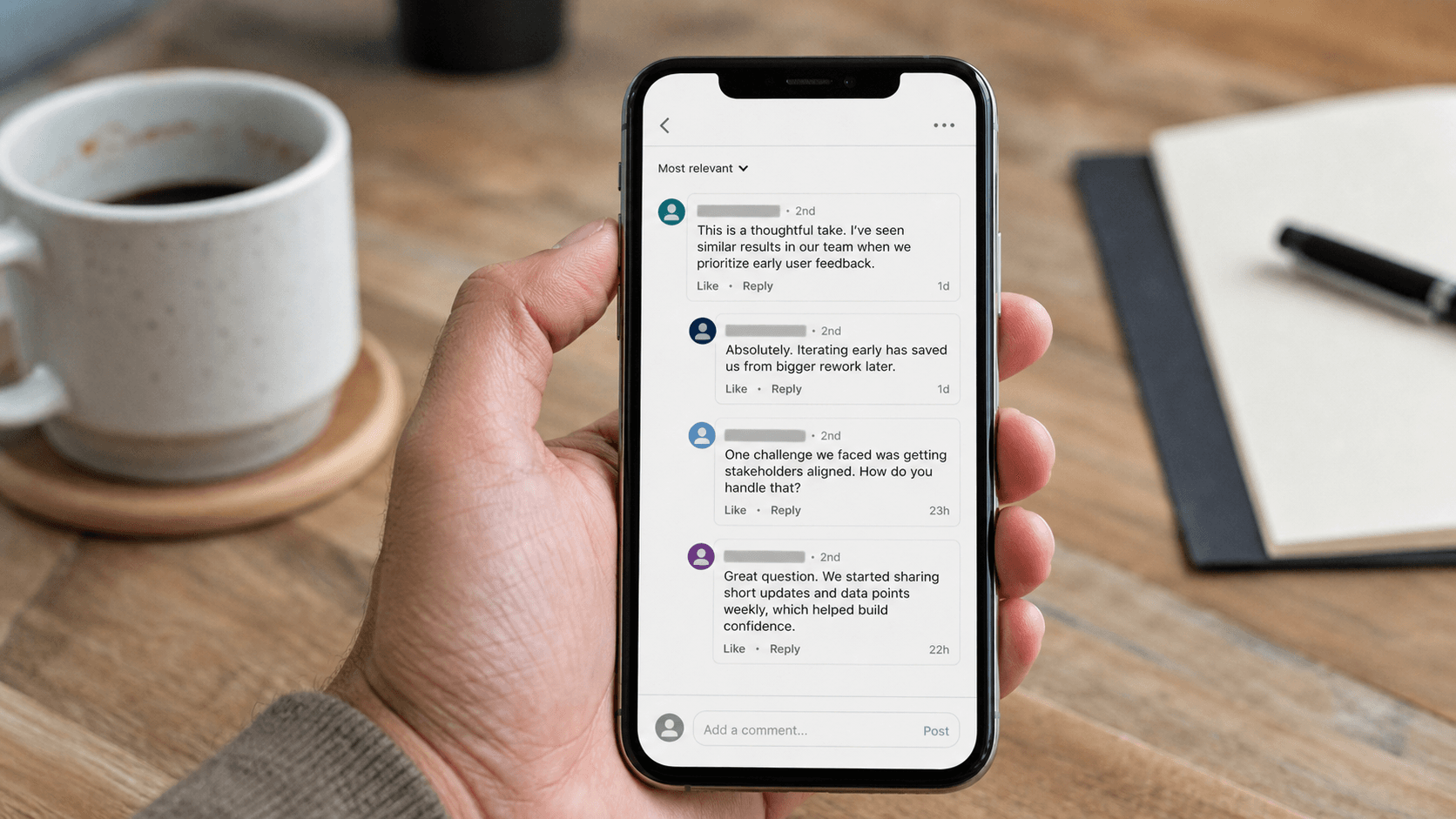
Oliver ran this experiment on himself. Six weeks, nothing published at all. Instead, five or ten minutes a day leaving real comments on other people's posts. Over 150 new followers in a month with zero posts, and around 30% of profile views now come from commenting rather than posting.
The reason it works is unglamorous. Commenting gives you a way into conversations without competing for attention only in the feed. You can walk into an emptier room, or you can queue for a full one.
Two rules separate this working from this being a wasted ten minutes.
Comment on the trigger, not the transaction. If you want honeymoons, do not go searching the word honeymoon, because by then people may already be shopping elsewhere. Search engaged. If you want family travel, look for the new job, the milestone birthday, the retirement, the house move. Get there before there is anything to sell.
And add something, or scroll past. "Love this" and "great share" do nothing for the person who wrote the post and nothing for you. If you cannot add a thought, a question or an experience, say nothing. Nothing older than about three weeks either. Late comments look like homework.
Turn that habit into a repeatable rhythm with The Ten Minute Daily Lead Routine.
Then stop losing the inquiries you already have
There is a version of this problem more expensive than having no leads, which is having them and losing them. You can generate inquiries and still lose them when response and follow-up are slow or inconsistent.
Speed comes first. We have seen advisors running an auto-responder promising a reply within 48 to 72 hours. That is not professionalism, it is a lead donation. Some prospects compare several advisors at once, so responding promptly helps you start the conversation while interest is fresh. Alexandra's view is that 24 hours is already too slow, and she is right. Acknowledge inside the hour even if the full answer comes later.
Then stop writing the sentence that kills the sale. Take "let me know your thoughts" and "any questions?" out of your vocabulary entirely. Both sound polite and both do the same damage: you have handed the buyer the job of inventing every objection themselves, alone, in their kitchen, with a calculator. Their decision turns logical, and you want them buying on emotion.
Replace it with a booked call. "If you're happy with it, great. Otherwise I've put some times in for Thursday, let's go through it together." Then screen share the itinerary and walk them through it. If they do not stop you as you go, they do not have questions.
And close the file properly. Around day eight: "Totally understand you're busy and this might not be a priority right now. I'll be closing your file in two days if I haven't heard back." That is the email people are most frightened of sending, but we have seen clients return from it months later and book.
The full process is in Sales and Follow Up for Travel Advisors.
For the four messages themselves, use the free Follow-Up Formula for quiet travel inquiries. It covers the day 2 reaction question, the day 5 value-add, the day 10 decision prompt and the day 21 closing email.
If those follow-ups still live in your inbox or notebook, compare the best CRM software for travel advisors and choose the smallest system that will make the next task impossible to miss.
The uncomfortable audit
Sit down on a Friday and count the things you did that week that got you paid. Then count the things that did not. If you cannot get to ten on the paid side, that is the whole diagnosis in one exercise.
Training is the easiest way in the world to feel productive without being productive. If you are three certifications deep and still have no clients, a fourth is not the missing piece. It is a very comfortable place to hide. Do You Actually Need a Travel Agent Certification? explains what is legally required, which credentials are useful and when another course is just delaying the work that finds clients.
There is an old line in this industry that if somebody asks whether you can ride a horse, you say yes, and then you go and figure it out. You will learn the product on the booking. That is not cutting corners. That is the job.
What to do this week
Five things, and none of them need a bigger following.
Write down five people who already talk to your ideal clients. Not business categories, actual names. Then have one conversation using the line above, which takes about four minutes. Set a ten minute timer each morning for commenting, on triggers rather than transactions. Fix your response time so every inquiry gets an acknowledgment inside the hour with a calendar link attached. And delete "let me know your thoughts" from every template you own today.
If you are not sure which of those five is actually your bottleneck, the Travel Advisor Growth Check will tell you. Nine questions, about three minutes, and it gives you one focus area, five next actions and a strength worth protecting. If you already know the answer is your pipeline, start with The 7-Day Lead Pipeline Starter instead: one task a day for a week to get a real lead source moving.
Common questions
How long before I see anything?
Referral partner conversations can produce an inquiry within a few weeks, because you are borrowing trust that already exists. Commenting takes roughly a month before the first DMs arrive. Neither is instant, and anybody promising instant is selling you something.
Does any of this change if I'm under a host agency rather than fully independent?
Not really. A host gives you supplier access, back office and product training, and those are worth having. None of them find you a client. If you are independent you carry more of the admin and get less of the training, but the client acquisition gap is identical, because it exists at almost every host too.
Would switching hosts fix it?
Almost certainly not, if this is your reason. A different host will teach you product as well. Switch for commission splits, tools or support if those are genuinely the problem. Do not switch in the hope that the next one teaches business development, because supplier money funds product training and nothing funds the rest.
Do I need a website before any of this works?
No. People visit your website after they have decided, to check you are not lying. Being findable matters more than being polished, and a complete Google Business Profile does more for most agencies than a website does in year one.
It has been a year. Is it too late?
No. The agency owners who come out the other side of this almost always changed one thing rather than everything. Usually it is the follow-up.
Is this just lead generation with extra steps?
It is the opposite of what most people mean by lead generation, which is usually buying leads from somebody else. This is building a source you own. We wrote about the difference in The Complete Guide to Lead Generation for Travel Advisors.
Talk to us
If you run a travel agency and you are not getting clients, you do not have a knowledge problem. You have a two-part gap, and both parts are fixable inside a quarter if you actually work them.
The fastest way to find out which part is yours is to talk it through with someone who has seen a few hundred versions of it. Book a free business audit and we will look at your business honestly, tell you the one thing to change first, and tell you if the answer is simply that you need more time. It costs nothing and commits you to nothing.
If you would rather start on your own, everything in our free resources is free and none of it needs an audit call first.


Oliver Catt ran Learning and Development for Unique Vacations, the worldwide representative for Sandals and Beaches Resorts. Alexandra Catt built her own travel business to six figures in its first year. Together they run Coaching Agents Through Travel, a business training community for independent travel advisors across the US and Canada. They are not a host agency and they do not recruit advisors.