
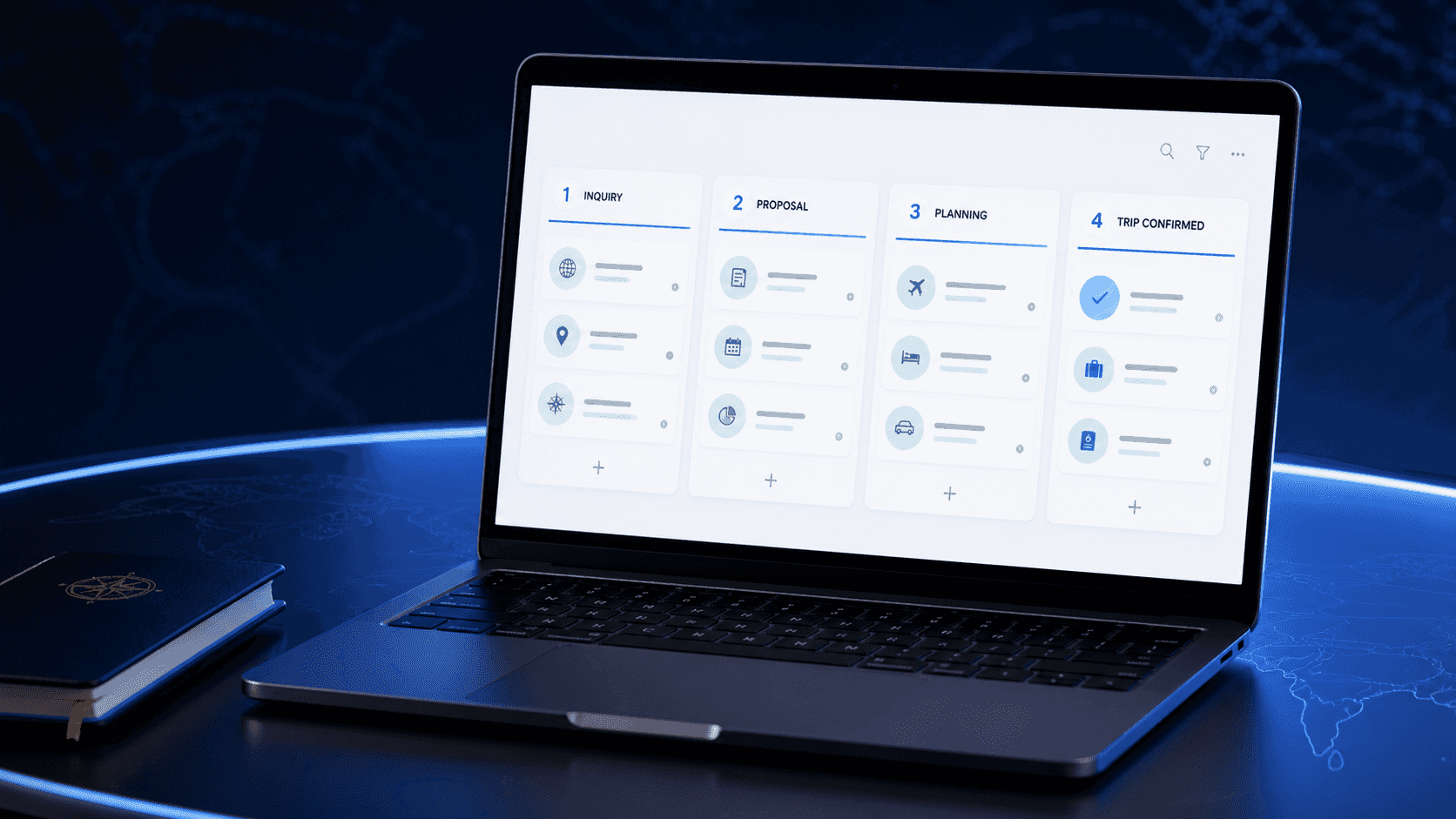
Short answer: there is no single best CRM for travel agencies, and the right CRM for a travel agency depends on what is actually broken. If your host agency gave you one, start there and back it up. If you need free lead capture and email, HubSpot. If you want marketing automation, funnels and SMS in one place, GoHighLevel. If you want beautiful client-facing itineraries and a website that feeds your CRM, Travefy. If you want the whole business in one system with commission reconciliation, Tern.
The expensive one you abandon in March is worse than the free one you open every morning. Pick for the job, not the feature list.
Not sure whether your CRM is the problem or your process is? That is exactly what a business audit can uncover.
The comparison, up front
| CRM | Cost | Travel-specific | Client itineraries | Marketing automation | Commission tracking | Best for |
|---|---|---|---|---|---|---|
| Host agency CRM | Free with your host | Yes | Varies | Rarely | Usually | Bookings and supplier data |
| HubSpot | Free, then paid | No | No | Basic on free | No | Free lead capture and a first pipeline |
| GoHighLevel | $97/mo | No | No | Extensive | No | Advisors who market seriously |
| Travefy | $39/mo billed annually | Yes | Yes | Light | Yes | Proposals, itineraries and a website |
| Tern | $35/mo annual; $49 monthly | Yes | Yes | Light | Yes, full reconciliation | Running the whole business in one place |
What a CRM is actually for in a travel business
A CRM is not a filing cabinet. It is the thing that stops you losing money you have already earned.
Most advisors we speak to run their business on a notebook, their phone contacts and their inbox. That works until you have twelve live inquiries at once, and then it stops working entirely. Something goes quiet on day four and nobody notices until day nineteen. That booking was already yours and it is gone.
What you actually need a travel agency CRM to do is short:
- Hold every contact in one place, with a note about where they came from
- Show which inquiries are live and what stage each is at
- Remind you to follow up on the specific days you said you would
- Capture new leads without you retyping anything
- Let you export the lot the day you want to leave
That last one matters more than any feature list, and almost nobody thinks about it until it is too late.
Start here: the free CRM your host agency already gave you
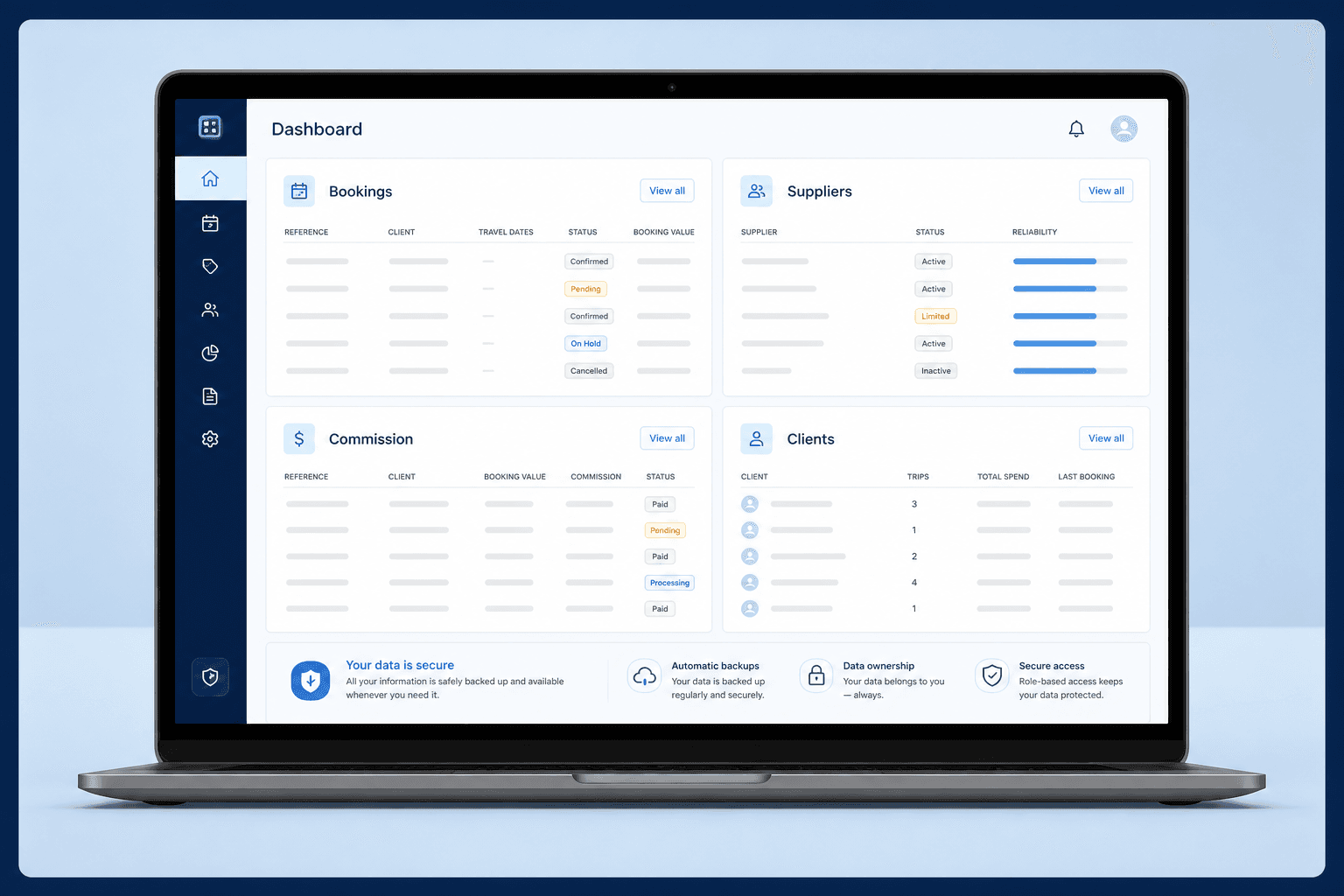
If you are with a host agency, you almost certainly already have a CRM. Use it.
It costs you nothing, it is already configured, it usually connects to the booking engine and supplier records, and in many cases it handles commission tracking. For an advisor in year one, that is genuinely enough. Adding a second system before you have used the first properly is a very expensive way to procrastinate.
But understand what you have agreed to. That data lives in their system. If you leave, they change platform or the relationship ends, pulling your client history out can sit somewhere between painful and impossible. We have watched advisors lose years of notes that way, and one of our own members put it plainly on a call: pulling that information sucks if you ever switch.
Keep a backup. A simple exported spreadsheet of names, emails, phone numbers, trip history and lead source, updated monthly, is enough. Ten minutes, and it is the cheapest insurance in your business.
The same rule applies to everything below. Before you commit, find the export button. If you cannot find it, that is your answer.
HubSpot: the free option, with a catch that changed

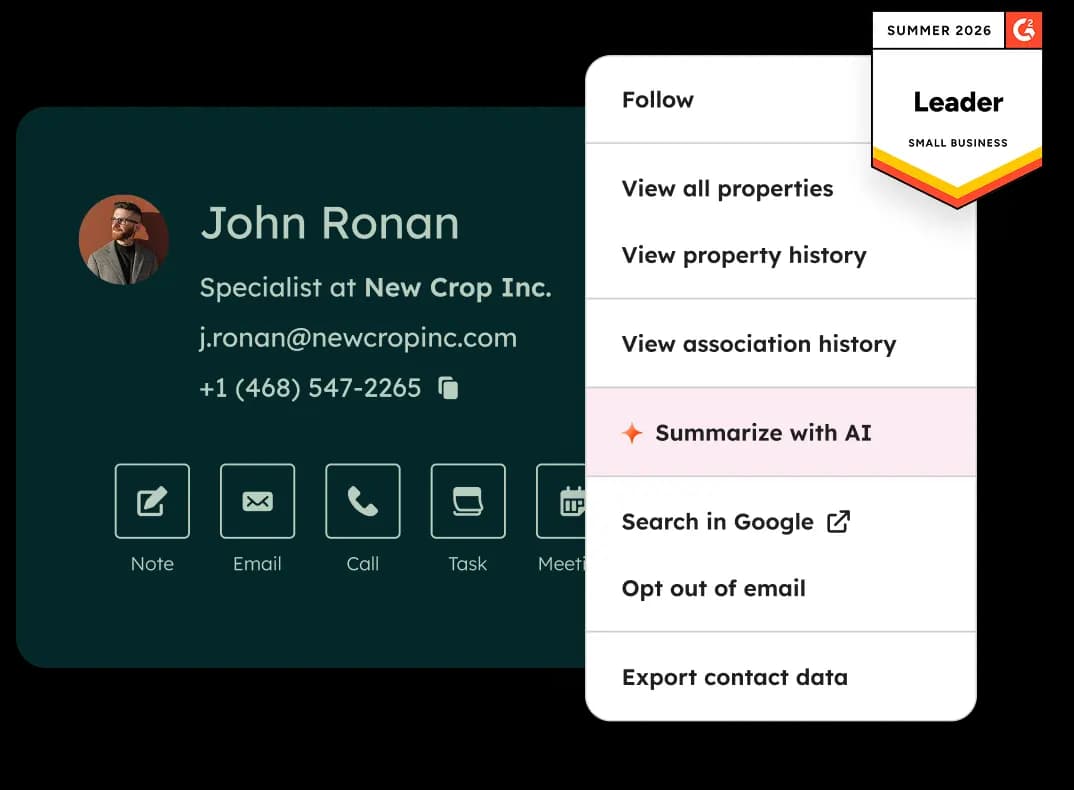
HubSpot is what we build live in our CRM, Email and Automation session, and it is still where we would send most advisors who have nothing.
What it gives you free is a contact database; one deal pipeline so an inquiry moves visibly from new to quoted to booked; tasks with due dates, which is what actually runs your follow-up; a form builder so a website submission drops straight in as a contact; landing pages; and integrations that can move new contacts into your email list without retyping them.
That last piece is the one people underestimate. Someone fills in your form, becomes a contact, joins your mailing list and enters whatever sequence you built, all while you are asleep. That is the difference between a lead being handled and a lead being forgotten.
The catch is real. HubSpot's free tier is much tighter than many older guides still claim. As of August 2026 it is free for up to two users, capped at 1,000 contacts, with one deal pipeline. There is no time limit on the free access, but there is a ceiling, and you may hit it. You also carry HubSpot branding on free forms and landing pages until you pay.
Verdict: still the best free starting point for lead capture and a first pipeline. It is not a long-term home if you are building a list of any size, and it is not travel-specific. It will never build you an itinerary.
Want the automation piece built with you rather than explained at you? The full build session is inside CATT. Book a free business audit first to check it is the right fit.
GoHighLevel: for advisors who market seriously

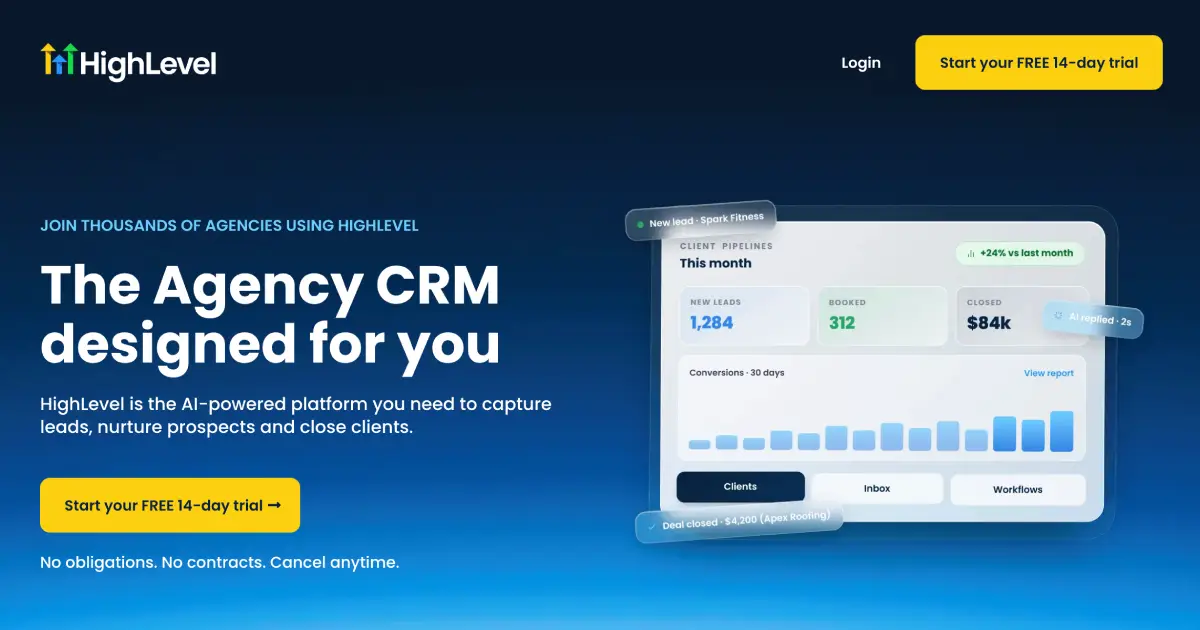
GoHighLevel is not a travel tool at all. It is a marketing platform, and that is exactly why some advisors love it.
The Starter plan is $97 a month and includes three sub-accounts, unlimited contacts and unlimited users. There is a 14-day free trial.
What you get is broad: CRM and pipelines, website and funnel building, email and SMS marketing, inbound and outbound calling, unified conversations, workflow automation, forms, surveys and quizzes, booking calendars, social media management, payments and invoicing, reputation management, courses and communities, plus AI tools.
For a travel advisor that translates into real things. A landing page for a group trip with a booking calendar attached. An SMS the moment an inquiry form is submitted, because speed to lead decides who gets the conversation. A nurture sequence for people who downloaded your cruise prep guide and are not ready yet. Every DM, text and email in one thread.
The honest downsides: $97 a month is real money for a new advisor. There are usage-based charges on top for SMS, calls, emails and premium AI. It is a big platform with a genuine learning curve, so you can pay for it and use ten percent of it. It also knows nothing about travel: no itineraries, supplier data or commission tracking.
Verdict: the right answer if marketing is your growth plan and you are willing to learn a big tool. Overkill if you have twenty contacts and no lead flow yet.
Travefy: travel-specific, client-facing and strong value

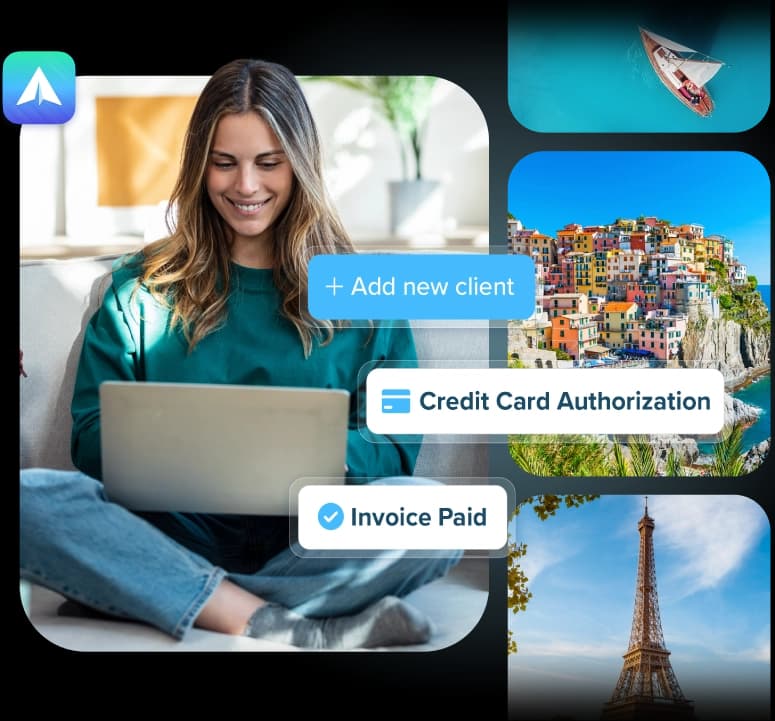
Travefy is built for travel advisors, and it shows in the part your client actually sees.
Pricing checked in August 2026 is $39 a month on the Core plan billed annually. Premium is $59 a month and adds priority and phone support, premium onboarding, a custom domain and business email hosting. Additional team seats are $20 a month each on annual Core, and a ten-day free trial is available.
Core includes the itinerary and proposal builder, a CRM with forms and automations, a website and landing-page builder, invoicing and commission tracking, mobile apps, email integration, AI content import and live chat support.
Two things matter in the way you actually work.
The client-facing experience. Clients get a branded itinerary they can open on their phone, with day-by-day detail, confirmations and documents in one place. That is the thing that makes a solo advisor look like an agency.
The website feeds the CRM. Because the landing-page builder and CRM are in the same product, an inquiry from your site can land as a contact with no copying and pasting. That is the loop many advisors miss when they run a separate website and spreadsheet.
The marketing automation is light compared with GoHighLevel. One of our own members also hit an email-connection limitation during a live call, so check the exact email setup you need during the trial before committing.
Verdict: the best value in this comparison if proposals, itineraries and a client-facing experience are what you are missing. At $39 a month billed annually, it is a practical way to stop looking like a beginner.
Tern CRM: the one that tries to replace everything
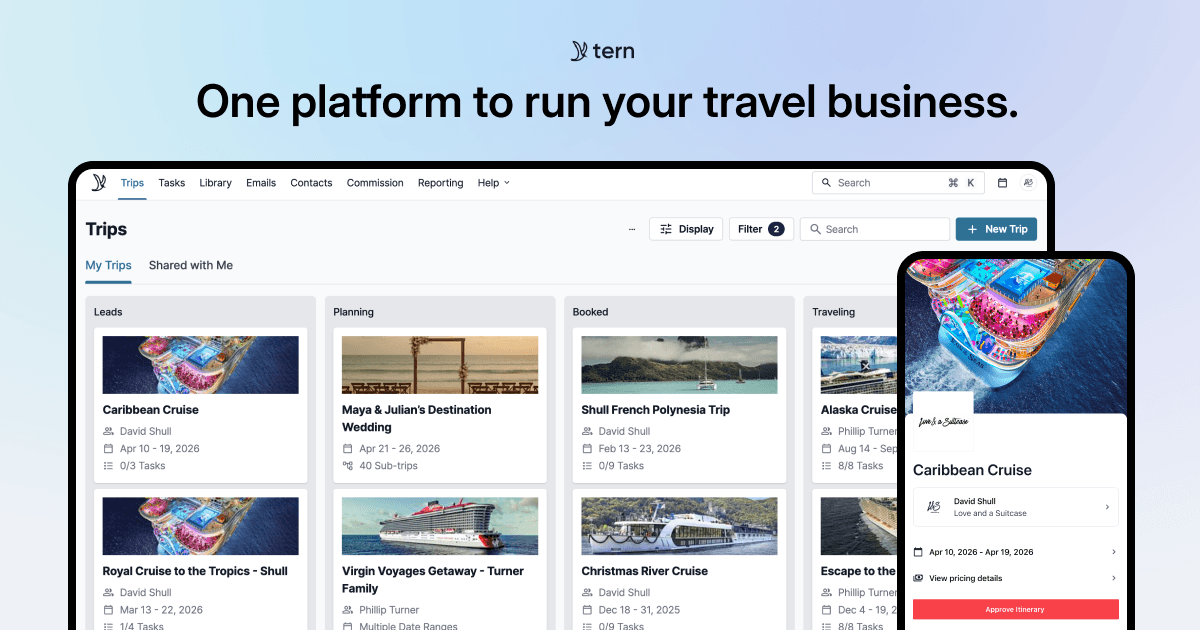
Tern is the newest of these and the most ambitious. It is explicitly built to replace your entire stack rather than sit alongside it.
Full-price individual access is $49 per seat per month when billed monthly, or $420 a year, equivalent to $35 a month. Agency pricing varies with billing term and team size, and the product offers a free trial.
If you want coaching and community alongside your software, read how the CATT + Tern partnership connects CRM tools with travel advisor training. It explains the annual membership offer and onboarding; this comparison remains focused on choosing the right CRM.
Every plan includes itineraries, a full CRM, AI tools with included usage, email integration, scheduling and booking, credit-card authorization, client forms and intake, and reporting. Agency plans at three seats and up add commission reconciliation, supplier-payment management, agency-wide reporting, team collaboration, a shared content library and centralized billing.
The parts worth knowing about:
- Forms that do the data entry for you. Drag-and-drop intake with smart syncing, including passport parsing.
- AI assistance with supplier content. It turns supplier emails and PDFs into itinerary content.
- Bookable content built in. Transfers, tours and activities can be added without leaving the platform.
- Commission reconciliation. Splits calculate automatically, supplier payments reconcile and payout statements generate in one place.
Tern is direct about what it aims to replace: your CRM, scheduler, itinerary builder, back office, forms and email marketing. That consolidation is the strength and also the risk.
The honest downsides: per-seat pricing adds up faster than Travefy for a small team. Heavy AI use may require an add-on. And consolidating everything into one vendor is the data-portability risk described earlier at maximum concentration.
For CATT members, separate the included standard advisor seat from optional paid upgrades. Included AI usage has limits; do not assume a Pro upgrade, agency-wide permissions or every advanced reporting feature comes with the membership. Check the current CATT + Tern plan details before paying.
Set up one inquiry-to-return workflow first, test reminders when dates change, and check your account's sharing permissions. Shared workflow templates are not a reason to share private client records. Existing users should confirm migration steps and any unused-subscription treatment with the team rather than canceling an account prematurely.
Verdict: the strongest option if you want one system for the whole business and commission reconciliation is a real job for you.
So which CRM for travel agencies should you choose?
Match the tool to the bottleneck. That is the whole method.
- You are brand new and have made fewer than ten bookings: use your host's CRM. Add HubSpot free if you need a capture form and mailing-list workflow. Spend nothing.
- Leads are going cold: HubSpot free adds a visible pipeline and task reminders; GoHighLevel adds SMS and deeper automation.
- Your proposals look amateur: Travefy, and you will feel the client-facing difference quickly.
- You are drowning in supplier emails and manual data entry: consider Tern for supplier-content assistance and passport parsing.
- You have sub-agents and commission is a nightmare: Tern, for reconciliation.
- Marketing is your growth plan for the next year: GoHighLevel, and commit to learning it properly.
- You are paying for three systems and using none: cancel two. We say this more often than you would think.
The software choice is only one part of the operating model. Business Systems for Travel Advisors explains the daily rhythm, onboarding and repeatable processes the CRM needs to support.
Set it up in an afternoon
Whatever you pick, the build is short and the mistake is making it long.
Create the account and delete the sample contacts. Import whatever list you already have, even if it is a messy spreadsheet, and add a column for where each person came from. Build one form, put it on your site or a landing page, and test it by filling it in yourself. Create one pipeline with three stages, no more: new inquiry, quoted, booked. Connect your email tool so contacts sync. Then set a monthly reminder to export a backup.
That is the whole thing. The failure mode is spending three weeks on custom fields you will never look at instead of putting real people into it.
The part no CRM will fix
Software does not follow up for you. It reminds you to.
The advisors who convert acknowledge an inquiry quickly, because some prospects compare several advisors at once and prompt replies help keep the conversation moving. An autoresponder promising 48 to 72 hours is a lead donation.
Then they work a real sequence: a walkthrough video, a light check-in, a value-add with nothing to do with price, an inventory recheck, and around day eight the email that closes the file: totally understand you are busy and this might not be a priority right now; I will be closing your file in two days if I have not heard back.
The CRM's job is making sure day eight happens. Yours is writing the email. The full framework is in Sales and Follow Up for Travel Advisors.
If you want a sequence you can put into that CRM today, use the free Follow-Up Formula for travel advisors: four timed touches, copy-ready wording, alternatives and a simple tracker.
If you are not certain systems are your real bottleneck, the Travel Advisor Growth Check takes about three minutes and names the one area to work on next. It is free, and it will tell you if the answer is something other than software.
Common questions
What is the best free CRM for a travel agency?
Your host agency's CRM, if you have one, because it is already configured and connected to your bookings. If you do not, HubSpot's free tier is the strongest option, but know the ceiling: two users, 1,000 contacts and one deal pipeline.
Is HubSpot's free CRM genuinely free forever?
Yes, with no time limit, but the caps are real. It used to allow far more contacts and now allows 1,000. Beyond that you need a paid tier.
Travefy or Tern: which should I choose?
Choose Travefy if the gap is proposals, itineraries and a client-facing website, and the lower annual price suits you. Choose Tern if you want one system for the entire business and commission reconciliation matters. Tern costs more per seat and does more.
What are the best Travefy alternatives?
Tern is the most direct alternative and positions itself against Travefy on itinerary building. Axus and Safari Portal sit in the same space. Advisors who only need a CRM rather than itineraries can use HubSpot or their host's system for less.
Is GoHighLevel worth it for a travel advisor?
Only if marketing is genuinely your growth plan. At $97 a month plus usage charges it is the most expensive option compared here, and it does nothing travel-specific. If you will use the funnels, SMS and automation weekly, it can earn its cost. If you will not, it will not.
Do I need a CRM if I only have a handful of clients?
Not on day one, but start one anyway. Retrofitting years of client history from your inbox is miserable and most people never do it. A free CRM with twenty contacts costs nothing and saves that job later.
Can I just use a spreadsheet as my travel agency CRM?
A spreadsheet works longer than people expect and beats an expensive CRM you ignore. What it cannot do is remind you to follow up on day four. That is the moment a spreadsheet can cost you a booking.
Should I use my host agency's CRM or my own?
Use your host's system for bookings and supplier data, because that is what it is built for. Keep your own contact list and marketing data separate, and export a backup monthly so you continue to own your client relationships.
Talk to us
The best CRM for a travel agency is not the most powerful one. It is the one open on your screen at nine in the morning with three tasks due.
If you want a straight opinion on your setup, book a free business audit. We will look at what you are using, what you are losing and whether the fix is a new tool or a better habit. It is usually the habit, and we will tell you that rather than sell you something.
Everything in our free resources is free and none of it needs a call first.