
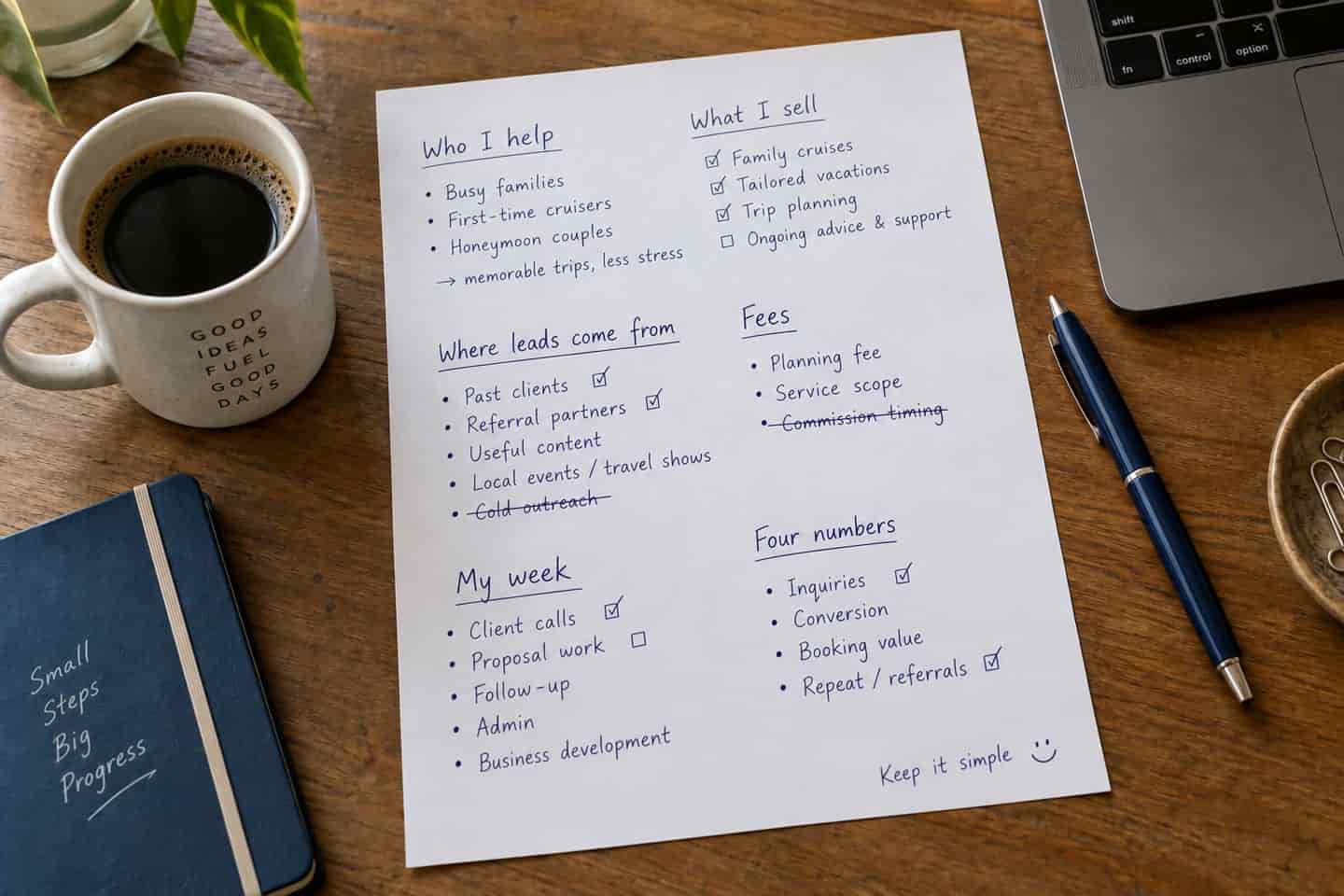
Not the forty-page kind, unless someone is lending you money. What almost every independent advisor actually needs is a one-page operating plan they look at more than once a year: who you serve, what you sell, where leads come from, what you charge, and the four numbers that tell you whether it is working. That takes an afternoon. The long version takes longer, may be required by a lender or partner, and can sit in a folder if you do not use it.
When you genuinely do need the formal version
There are real situations where a full document may be required, and they generally involve someone else's money or someone else's rules.
A bank loan or a line of credit. An investor or a business partner coming in. Certain visa applications. A franchise or a host agency that requires one as part of onboarding. Some grant programs. If you are in one of those situations, write the full thing, follow the format the recipient asks for, and get the financial projections looked at by an accountant.
For the distinction between a lean internal plan and the sections a lender may expect in a traditional plan, the US Small Business Administration's business-plan guidance is a useful starting point. Requirements still depend on the recipient and your circumstances, so treat the format as a planning guide rather than a guarantee of approval.
If none of those situations apply to you, and for many independent advisors none of them do, the long document can become procrastination wearing a suit. It feels like progress because it is hard work, and it produces nothing a client will ever notice unless it helps you make a decision.
The one-page plan, section by section
Write this on one side of one page. If it runs to two, you are explaining rather than deciding.
Who you serve. One sentence describing an actual person, not a demographic. "Couples in their fifties who have done the all-inclusive thing and want something harder to book themselves" is a plan. "Anyone who wants to travel" is not, and it is the single most common reason an advisor's marketing does not land.
What you sell, and what you do not. Name the trip types you want. Then, and this is the part people skip, name the ones you will turn down. An advisor who will take anything is an advisor whose calendar fills with low-value work that crowds out the good clients.
Where leads come from. Three sources, named specifically. Not "social media" but "referral partners, my own past clients, and the local parenting group I am actually in." If you cannot name three, that is the finding, and it is more useful than the rest of the page put together.
What you charge. Your planning fee if you have one, when you charge it, and what it covers. Write the sentence you will say on the phone when someone asks, because the moment you have to improvise that sentence is the moment you undercharge.
Your week. Which days you do client work, which you do marketing, which you do admin, and when you stop. An advisory business can struggle with consistency rather than strategy, and consistency is often a calendar problem.
The four numbers. Below.
Business Systems for Travel Advisors: Productivity, Process and Staying Consistent covers the routines that make a plan usable week after week.
Download the one-page plan
If you want a blank copy to fill in, unlock the free one-page travel agency business plan template with your email. The resource page includes a fictional sample and a worked example to guide you, plus a fillable PDF with room for your own answers. Use it as a working page, not a document to file away.
The four numbers that actually tell you anything
Forget revenue for a moment. Revenue tells you what happened, not what to change.

Inquiries per month. The top of everything. If this number is low, nothing further down the list is your problem, and no amount of improving your proposals will fix it.
Inquiry to booking rate. Of ten people who ask, how many book? If inquiries are healthy and this is low, the problem is qualification, follow-up, or the conversation itself, and those are all fixable.
Average booking value. Whether you are working on trips worth working on. Doubling this may be easier than doubling inquiries for some businesses, but it depends on your market and offer, so test rather than assume.
Repeat and referral rate. What proportion of this year's business came from someone you already knew. This is the number that separates a business from a treadmill, and it is the one nobody tracks.
Track them monthly on the same page. Four numbers, twelve rows, one sheet.
The Complete Guide to Lead Generation for Travel Advisors helps with the first number when the inquiry line is too quiet.
The travel agency marketing plan is the half everyone skips
A business plan without a marketing plan is a wish. The marketing half does not need to be long either, but it does need to be specific about three things.
What you will publish, and how often. Pick a cadence you can hold on your worst week rather than your best one, and put the actual days in the calendar.
Which channels you are genuinely going to work. Two done properly beats five done occasionally. For many advisors that is one social platform plus one owned channel like email, and everything else is optional.
How someone gets from seeing you to talking to you. This is the step that is usually missing. There has to be a path from a post to a conversation, and if the only route is hoping someone sends a message, there is no path.

Travel Advisor Marketing: A Practical Playbook for Content, Social and Visibility expands the channel choices without asking you to work every platform.
Review it quarterly, not annually
An annual plan is a document. A quarterly plan is a tool.
Every three months, sit down with the page and the four numbers and ask three questions. What actually happened compared to what I wrote down? What did I learn about who I want to work with? What is the one thing I am changing for the next quarter?
One change per quarter. Not five. Advisors who change five things learn nothing, because they cannot tell which one worked.
When the plan and reality disagree, reality is right
You will write down a target client and then discover that the people who actually book are somebody else entirely. That is not a failure of the plan, it is the plan doing its job, and the correct response is to change the page rather than to keep trying to make reality comply.
The advisors who grow steadily are not the ones with the best plan in January. They are the ones still holding a page in October that has been rewritten three times and matches what is actually happening.
How to Grow a Travel Agency: From First Bookings to a Real Business covers the next stage when the operating plan starts producing a pattern.
Common questions
Do travel agents need a business plan?
Only a formal one if you are borrowing money, taking on an investor, or a host agency, franchise, grant program or other recipient requires it. Otherwise a one-page operating plan covering your client, your offer, your lead sources, your pricing and your weekly rhythm will do more for the business than a long document you never reopen.
What should a travel agency business plan include?
Who you serve, what you sell and what you decline, where your leads come from, what you charge, how your week is structured, and four tracked numbers: monthly inquiries, inquiry-to-booking rate, average booking value, and repeat and referral rate, plus the assumptions behind those numbers.
How long should a travel agency business plan be?
One page is enough for an internal operating plan. If it is going to a lender, investor, grant program or other recipient, follow the format and level of detail they ask for, including financial projections if required. The right length is the length that helps you make decisions and satisfies the person reading it.
What is a travel agency marketing plan?
It is the section that says what you will publish and how often, which two channels you will genuinely work, and the specific path a stranger takes from seeing your content to starting a conversation. Most plans describe the first two and leave out the third, which is the one that produces inquiries.
How often should I update my business plan?
Quarterly. Review what happened against what you wrote, what you learned about your clients, and pick one thing to change for the next three months. One change per quarter makes it easier to tell what worked and whether the change helped.
Do I need a business plan to join a host agency?
Usually not, though some hosts and franchise models ask for one as part of onboarding. Check with the host directly, because requirements vary and an unnecessary document is a poor use of your first month before you have even begun serving clients.
Is there a travel agency business plan template I can download?
Yes. Use the free one-page travel agency business plan template linked in this article as a practical sample and example. Fill it in with your client, offer, lead sources, pricing, weekly rhythm and four numbers, then review it quarterly so it stays useful.
Talk to us
If the hard part is not writing the plan but working out who you are actually for, that is the conversation worth having first.
Or take the Growth Check if you want to identify the business area to work on first.


Oliver Catt ran Learning and Development for Unique Vacations, the worldwide representative for Sandals and Beaches Resorts. Alexandra Catt built her own travel business to six figures in its first year. Together they run Coaching Agents Through Travel, a business training community for independent travel advisors across the US and Canada. They are not a host agency and they do not recruit advisors.